An excellent point is made in this Indexed about ideas. If only we had infinite time and resources to pursue things.
Category: Opinion
-
Why I will Never be a Politician
I will never be a politician. One of the reasons is because if I were, I’d have to say stuff like this:
The process used to get this bill to 60 votes was unlike anything I had never [sic] seen before. Deals were cut behind closed doors for individual senators and their states at the expense of taxpayers across the nation – and that’s just not right. The majority leader also made a compromise on abortion – where, morally, there can be no compromise – to get his 60th vote.
Saxby Chambliss’ (R-GA) full statement about the health care bill senate passage can be found at GeorgiaFrontPage.com. As an amusing aside, I would have preferred to link directly to something on Chambliss’ website, but there’s nothing there. How do you let people scoop you with your own statements?
Why won’t I ever be a politician? Because statements like that would really stick in my craw. It’s unbelievable (yet existent, so it must be believable) pandering to his Republican base which is entirely understandable, yet the wording is insane.
It’s understandable because the base is what elected him. He needs to make sure the people who don’t look deeply into things know that he’s not into this back-room deal-making fiasco that is Washington Politics nor does he support abortion. I can just hear Joe Six-Pack sitting in his barcalounger shouting “Fuck Yeah!” at Fox News, but as I just said, that statement is insane.
First, “The process used to get this bill to 60 votes was unlike anything I had never [sic] seen before.” Really? I doubt it. This might be factual in the sense that he’s never seen precisely this sort of sausage being stuffed, yet when he was elected to the Senate in 1994 the Democrats held a 56/44 majority in the Senate. There must have been similar struggles. This statement is just so much bumph I don’t want to think about it. When has politics not been about back room deal making? Like or hate it, that’s the truth.
Second, “The majority leader also made a compromise on abortion – where, morally, there can be no compromise – to get his 60th vote.” This statement is also factually true yet fundamentally false. The Majority Leader made a compromise that moved the abortion issue closer to where a Republican like Chambliss would like to see it: No Federal funding. So, yes, Harry Reid compromised abortion by moving toward the Republican end of things therefore quote-mine the word “compromise” out of that and beat the Democrats over the head with it in order to pander to the voters. I’m not going to even discuss the rectitude of “no compromise” with respect to abortion or any other thing.
Third, I personally understand exactly why Senator Chambliss said what he said. I also understand that if I were in his shoes, I would be doing exactly the same things because that’s how the game is played. And that’s why I could never be a politician. While I see how the partisan process functions, I have no desire to twist my ethics into the knots required to make statements such as that above. It would be nice if we lived in a country where every citizen took the time to know the issues and become involved rather than repeating talking points on major items that have been ingrained into us by ideologues, however that is not the country we possess. Unfortunately.
-
Muse: Uprising
Because I just bought this album, think it’s pretty good, and want to share with you their weird video.
-
Internet and Other Surveys
I hate surveys.
I hate them because you cannot trust them.
Why can you not trust them? Because generally you only see the “results” through the lens of the medium that is reporting them. Be it Fox News or CNN or the Obama Administration or (I’m not trying to pick on politics here) Habitat for Humanity or Greenpeace or whomever, they all have their own axe to grind so rarely will you be able to review the survey questions or the actual results.
Peer-reviewed work is of slightly higher caliber, but even in peer-reviewed articles it depends on the quality of the reviewers. Do these people have any education in the ethics and preparation of survey questions? Sometimes that answer is a loud, “Hell No!”
This post was prompted by two things, one lesser and one greater. First the lesser:
I had seen a blog post that was a link to a link to a link to a link that finally let me to this “study” by retrevo.com that produced some (in my opinion) questionable statistics about iPhone users (In defense of retrevo, I’m sure they did their survey to generate content and buzz, not from any deep seated need to academically refine their audience database). As I mentioned in my twitter about it this morning, I couldn’t find anything blog-worthy in it and so decided to just let it be.
That is until I read the latest posting on fivethirtyeight.com about the fabrication of poor performance by Oklahoma students by a polling research firm. This would be the greater thing.
As an aside, I tend to read items that originate in Oklahoma because over half of my direct family lives out there. Same way I tend to read new stories that come from Northern California where another portion of the family tree is at root.
As a further aside, I just discovered a bias in myself. While I will read news stories from Oklahoma and lump them in as “family affective” I will only pop up and read stories from the communities immediately surrounding Santa Cruz. Communities which do not include San Francisco, Oakland, etc. My geographic filters for “family affective” stories seems to have some skew.
Asides over. The story out of Oklahoma is about how Strategic Vision LLC likely fabricated the survey results for how well Oklahoma High School students could do on a basic citizenship exam. I say likely because an Oklahoma Legislator duplicated the study as well as possible and got entirely different results. Fivethirtyeight covers it much better than I.
Which brings me back to my original point. Survey reporting cannot be trusted, but Americans don’t think about this. How many people know that the “margin of error” reported on every poll during the political campaign season means absolutely nothing without also knowing the confidence interval used?1 How many people know that margin of error is not some “unknown voter factor” but actually a hard and fast number determined by the number of people polled and that confidence interval I just mentioned? Only people who have some background in statistics. News outlets have no incentive to educate the public, they merely want to report the polls in a way that garners the most viewers/readers/clickthroughs.
Surveys and polls too often do not allow you to research their basis: The questions, who they surveyed, what statistical methods they used, how the random sampling was conducted. Even with the best of intentions, surveys can be skewed by the order of questions, placing people in a particular frame of mind.
Do not trust survey results! At least, do not trust them over your own judgment unless you can see the guts of the work.
That is all. Off to drink less coffee.
1: I assume that most pollsters use a 95% confidence interval, but I have no real knowledge about that.
-
Writing

Do you enjoy writing? I do. I find it soothing to arrange a sentence to explain my message, whatever that message happens to be.
By no means do I consider myself an expert. I know that I’m wordy and verbose and break some of the cardinal rules such as “write with nouns and verbs” (rather than “write with awesome nouns and superlatively cool verbs”). I think I’m proficient and reasonably understandable. It helps that I spend a good portion of my daily work life in the writing of various corporate documentae. These may not be Tolstoy, but they force me to write coherent sentences and paragraphs, all of which eventually contribute to a document of one type or another.
Add to that my blogging behavior. Again, this isn’t high literature but it is writing and the more you write, the better you write. As I saw on Merlin Mann’s blog the other day:
The Top 1 Behaviors of Successful Writers: They Write
This is good advice and the thrust of Merlin’s message was that if you boil down the writing advice columns and the author productivity interviews, you eventually end up with that one nugget of info. Just write.
Everybody is talking about writing this month because it’s NaNoWriMo1, but we should be talking about it all the time (or writing about it, or waving about it). Writing well is a critical skill in the online world. Just as people draw associations between accent and education, the presentation of your written words will have an impact on how people view your abilities. In a knowledge economy where you are forced to interface with clients and collaborators through online textual means, your writing can set you apart or set you aside.
As an aside, this is one of the complaints I’ve heard about Google Wave (beta). If you are involved in a wave with someone, they can see you typing—actually typing, character by character—including all your deletes and rewordings and edits. While that might be a new paradigm, I for one am not ready for people to view the sausage making that is my writing process. Google says the feature to turn that off is coming.
So what to do? How should you improve your writing: Should you listen to the advice of NaNoWriMo and just write write write without stopping for edits or rework? Sometimes I do that. I recently compiled a document2 by doing a stream of consciousness dump onto a text file for about an hour and then piecing it together into a coherent whole. I threw out about half of what I wrote, but it allowed me to “fill the corners” and catch all the detail that I wanted without my brain having to worry about how well the document sounded.
Should you outline? Some do. I don’t. I don’t believe in outlining. Outlining isn’t writing; outlining is planning and sometimes it’s easier to outline after the document is complete. In other words, you finish a draft and then realize there’s a heading topic missing so you go back and fill it in or reposition your existing text to cover the gap. I have outlined to set tasks for a team of people who were working the same item, but it’s an exception for me.
Should you do writing practice? Some do. I don’t see the point. Fiction authors may disagree with me here. They will probably state that doing writing exercises helps to develop their various voices. I won’t argue the point. I don’t write much fiction so I’m hardly an expert. My opinion is that you might as well practice writing while producing real content. Sure, the things you’re generating right now might suck, but everyone has to go through that phase. There’s no reason to hide it. Any reasonable person will recognize that sometimes you just can’t be Shakespeare.
As another aside, I can’t count the number of times I’ve read a document that I wrote some amount of time before and thought, “Who wrote this piece of shit? Oh, right. I did.”
The only other thing to do if you want to write, and write well, is to read. Important writing people will say “read the classics” or “read big books” but given the quality of writing available that is out on the web nowadays I say, “read”. Although I will draw the line and emphasize that you shouldn’t read the comments on YouTube.
Now that I’ve pontificated on that topic, I must go and practice my preaching. Talking Traffic has been woefully neglected. I plan to have several episodes ready to go before I start recording again so that I may keep a more regular schedule.
1: I decided to keep track during NaNoWriMo of how much writing I do on a normal basis. I’m abusing NaNoWriMo’s interface to keep up with my progress even though I’m not novelizing.
2: My use of the term “document” in this posting is of a general nature. While I’m alluding to corporate writing in some cases, my “documents” include blog postings, corporate memoranda, emails, love letters, twitter tweets and forum postings,etc.
-
Scott Sigler's The Rookie
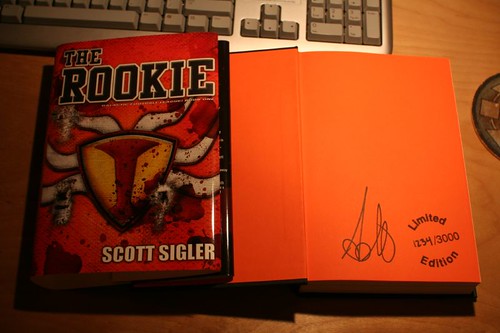
Do you like Football? Do you like Science Fiction? Do you like Corruption and Drug Dealers and the Mafia? Then you’ll like Scott Sigler’s self-published book, The Rookie.This book is available by podcast, but I’m a fan of having paper in front of me.
This particular book was something new for me because it’s the first book I went out to buy with the specific intent of picking up a limited edition hard back for posterity’s sake. There’s plenty of valuable books on my shelves from an emotional perspective, but not too many that might be intrinsically valuable somewhere down the road.
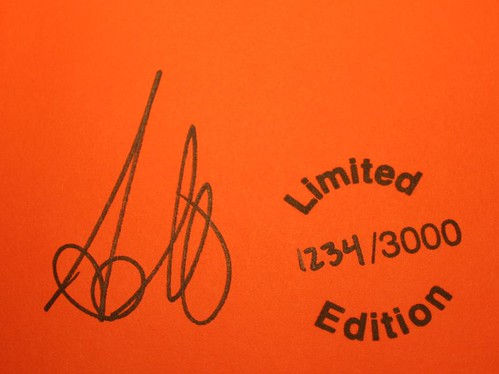
I think the value might come out of the rad-awesome number of my book.
The story? Good. Especially if you like football, but you don’t need to enjoy football to like this book.
-
What to do with your Corpse?
Over at MAKE is a link to a novel concept. Turn yourself into pencils when you’re dead.
Each pencil is foil stamped with the name of the person. Only one pencil can be removed at a time, it is then sharpened back into the box causing the sharpenings to occupy the space of the used pencils. Over time the pencil box fills with sharpenings – a new ash, transforming it into an urn. The window acts as a timeline, showing you the amount of pencils left as time goes by.
So basically you have a constant reminder of a lost loved one. For a lifetime, according to the designer. This makes me hearken back to Message in a Bottle where the sailor dude is so bereft by the loss of his wife that he can’t have anything in her studio out of place.
This idea doesn’t strike me as all that healthy. I won’t be investing.
-
Teddypocolypse!
I like this song, even though every time I hear it I think I’m listening to Dr. Who for the first several bars.
The video is interesting. The best part starts about 3/4 of the way through.
-
How Skynet Conquered Humanity
We saw Terminator Salvation last weekend. As I mentioned in my post, it was an acceptable movie, with a few plot holes, but then it involves a story premise surrounding time travel and that makes it difficult to avoid holes.1 The movie once again made me question what a world-spanning evil computer/cyborg/machine-entity would be doing with devices and tactics so similar to what humans use.
I’ve thought for a while that a great idea for a science fiction short story would be to explore how a Skynet-esque machine intelligence would go about conquering humanity. I throw this out there for anyone who wants to write it. For example, how did Skynet survive the nuclear holocaust it unleashed? Where did it get its power from? How did it go about manufacturing all those nifty hunter-killers and terminators? There’s a lot of niggly details glossed over in the movies between Judgment Day and the industrial juggernaut of the 2018 Skynet.
So, if you were a machine bent on destroying humanity but at the same time preserving your own particular self, how would you do it?
1: The only time travel movie that I can recall getting it close to “right” is the latest Trek film. Somebody went back in time to change history and the history changed. Of course the same characters ended up doing the same things which goes to show that no matter how much the trek people mess with the time stream, it never alters. I think they need to start chanting the Ron Moore quote, “It’s not about plot; it’s about the characters”.
-
Hugo: Best Novel
Tomorrow is the deadline to vote on the Hugo Awards for this year’s Worldcon. Does this mean anything to YOU? Only if you purchased a membership and are eligible to vote. If you did, hopefully you’re not a big fat procrastinator and have already taken care of this little matter. If not…
You may recall that I’ve set myself a little project, namely to read the novels that have been awarded the Best Novel Hugo and declare whether or not I like them. My track record has only been so-so. This dovetailed nicely with “real life” because when the nominations for the 2009 Hugos were announced I was pleasantly surprised to discover that I’d already read three of the five nominated novels: Anathem, Little Brother and Zoe’s Tale. Graveyard Book was already on my list to go read, so I just had to pick up Saturn’s Children. Now I have, and I can give you my ineligible vote:
The Graveyard Book, by Neil Gaiman. Hands down. No question. Best book I’ve read in quite a while, actually. It’s got a spectacular riff off of Hillary Clinton’s book It Takes a Village in the first chapter which cemented my love. This book is everything that Neil Gaiman is capable of.
Anathem, by Neal Stephenson was exactly what we’ve come to expect from him: Huge, full of cool edgy science fiction and tedious amounts of philosophizing. I’ll keep reading him, but it can be a chore.
Little Brother, by Cory Doctorow would be my second choice for best novel. It was a great story mixing suspense with action and drama.
Zoe’s Tale, by John Scalzi was an excellent book but didn’t quite live up to the Scalzi reputation. It suffered from being a rehash of a previous story from a different character’s perspective.
Saturn’s Children, by Charles Stross had (as usual for Stross) excellent scifi elements but (to me) implausible story and political elements.
So, that’s my opinion. Of course, by the very fact that I bother to review these books, it should be assumed that they are worthy. For example, I hesitate to criticize Zoe’s Tale because I know for a fact, from reading his blog, that John Scalzi and others regard this as one of his best works. I respectfully disagree, but then I think my reading tastes don’t much march in line with what people consider “best works.” But then, I’m not really criticizing Zoe’s Tale per se, I’m only saying, “stacked up against the other four Hugo-nominated novels, it does not win.” I’m saying the same thing with four of them.