Category: Opinion

  • Atlanta Metro Area Accessibility

    Office Parking Lot: Wednesday 1/12/11

    We who live and work in the Atlanta metropolitan region had an object lesson in what happens when a major snowstorm hits a southern city: shutdown. You might assume that this has implications for accessibility. You would be right.

    The Storm

    The snow that hit us on Sunday night put five inches on the ground at my house in the northern suburbs and I’ve seen reports ranging between two and nine, depending on the area. However, the snow wasn’t the big problem. It was the sleet and freezing rain followed by a cold snap in the 20’s that froze everything hard that transformed what might have been a significant winter event into snowpocalypse. Following that with a Monday where temperatures edged into melting territory only to have them plunge overnight—then a Tuesday and Wednesday (so far) where the sun played its important role in slightly melting everything only to have it refreeze after ye olde solar orbe disappeared—we have been presented with a region-wide problem.

    The Results

    It hasn’t been possible to move about in anything like a normal fashion. MARTA, Cobb County Transit, and Gwinnett County Transit, to cite only a few, didn’t run at all on Monday or Tuesday and with only limited service on Wednesday (MARTA Trains ran a reduced schedule those three days).

    Major roads were “passable” on Wednesday but were horrible on Tuesday and death-defying on Monday. Minor roads were in some respects better but in others much, much worse. Suburban subdivisions were almost impassable depending on the terrain and how much sun the roads had received. In fact, many were actually impassable, keeping their residents at home even if they desired to leave. City streets were in similar conditions as crews worked to keep main arteries open with limited equipment and resources.

    The Underlying Problem

    The whole situation has illustrated something about Altanta and its surrounds that is not as true in other eastern United States metropolitan areas: We are mostly dependent on the automobile as a central driver (no pun intended) of our economy. For example, I live in northeast Cobb County. I work in southwest Gwinnett County. I have a 35 mile one-way commute and I am by no means alone in that distance. On Monday I didn’t think even once that it was possible to make it to work. Tuesday I briefly considered it, but one look at Georgia Navigator convinced me otherwise.

    Atlanta, Noon, Snowpocalypse. This was Monday's map but it's representative of Tuesday

    If you can’t get to work, or to school, or to the store, then some of the basic transactions that power our economy do not function.

    My personal problem was that there were no options for getting to my office outside my car or my bike or my own two legs. This particular storm put the kabosh on any transit option that might have existed, but for the sake of argument let’s postulate a scenario where the snowy/icy conditions were keeping me stuck in my own house1 but that MARTA, Cobb County Transit and Gwinnett County Transit were still operating. There would still be no method for me to get to work unless I caught a ride by car2. It isn’t possible for me to walk a reasonable distance and then catch another tranportation method.

    Beyond the Ice Event

    This has other not-unreasonable implications for transportation blockage: A year and a half ago we had serious flooding in the region that shut down a lot of the major river crossings of the Chattahoochee. That pinched the options that remained by shoving all the traffic through those chokepoints. There wasn’t any option but to suck it up and sit in traffic for twice as long as normal. Rideshare would have been effective, but my schedule is such that I can’t commit to a particular commutting time. Buses would have been an option, but again see 2 below.

    Atlanta is heavily dependent on the single-passenger vehicle. This is obvious yet regarded as inevitable and unchangeable. I agree that there are huge obstacles to making this region more accessible by alternative means of transportation however it’s not impossible to move things in the right direction. We just need to be aware of the challenges and work to overcome them.

    We have the privilege of living in one of the least dense metropolitan areas in the United States (census 2000). We’re ranked 18th in population but 64th in population density. This means it’s more expensive to serve the same population with traditional transit options than it would be in New York or San Francisco. And while we’re making efforts to provide better options for cyclists to coexist safely with automobiles, the distances involved for those people (like me) who live in the suburbs preclude a total cycle commute. Also, there are choke points such as river crossings which are auto-centric and cycle-unfriendly. We also have a politcal arrangement in the area which makes it difficult to have central policy making for the metropolitan area as a whole and this is compounded by state politics which, for better or for worse, are focusing more and more on the disparities between the Atlanta region and the rest of the state.

    I personally regard one of the bigger problems at the moment as people’s inability to relocate. It’s a down economy with a down housing market; a great time to buy (if you can get a loan) but a bad time to sell. I am planning to practice some of what I preach, assuming we can sell the house for a reasonable amount. We will move ourselves, our cat and our stuff to a place where I will have transit options and I might get to work in Norcoss by 9:00 rather than 11:00. If people voluntarily start placing themselves where the facilities already exist, there will be incentive for policy makers and others to support that activity. On the flip side, if no efforts are made to provide alternative means of transportation, there will be no incentive for people to move. It’s a vicious chicken/egg proposition.

    This problem has developed over the long term and will only be solved over the long term. However, long journeys are completed through short steps. Let’s make this region a more accessible place for our kids.


    1: With my driveway that is not an impossible occurrence. Jenn’s car won’t leave the garage at least until Saturday, if not Sunday.
    2: Not wholly true, but true for all practical purposes. I once did the math to see what it would take for me to get to work by transit. First step: bike or walk 6 miles to catch a bus. Two trains, two buses, and two system transfers later, ending with a one-mile walk/bike, I’d be at work. Time of departure: 6:00 AM. Time of arrival: 11:00 AM. I don’t consider that useful.

  • Idimager vs. Lightroom

    30 Aug 2013 update: Note that this discussion (along with the second one) has been deprecated by Photo Supreme supplanting Idimager. The following discussion isn’t relevant anymore.


    A while back, I exceeded the useful capability of Adobe Photoshop Elements for keeping track of the digital images that I have on the hard drive. The program worked great for the image manipulation that I require (not much) but as a database it just wasn’t cutting the mustard. So off I went to find something to replace it for database purposes.

    A good friend of mine recommended Idimager, a database management software tool that has a lot of powerful and (once you figure it out) intuitive features that make finding images a snap1.

    Idimager’s main competitor in this process is Adobe Lightroom, a companion software to Photoshop, which everyone is familiar with.

    Both of these software, Idimager and Lightroom, are workflow software: they take you through the steps from downloading images through tagging and categorizing to manipulation (batch or otherwise) and finally to publication. One important difference is the cost: Idimager was $139 while Lightroom was $299. I wasn’t ready to shell out the dough for Lightroom, so I decided to give Idimager a shot.

    That was about a year and a half ago. Since then, I’ve been happy with a number of aspects of Idimager and sad about others. I’m very happy about its image tagging and categorization features. Those are fabulous-rock-awesome-oh-yeah without any need for exaggeration. Those images that I’ve tagged as “Jennifer Bowie” are easy to find. Same with all the ones marked “Races”. With multiple subcategories, drilling down to a particular race is also easy. I’ll praise Idimager to the skies for those features.

    However, I’ve had difficulty getting it to smoothly act as a database. By smoothly, I mean seamlessly and flawlessly importing and tracking the 40,000+ digital images that are sitting on my HDDs. For example, I’m putting together a list of pictures to print for an annual photo album2 but as I’m going through all my 2008 images I notice that some are not in the database catalog. Why? I have no idea, and neither did the forums. It was suggested that I could just reimport those folders and it would bring the missing images into the catalog non-destructively but I actually discovered something a bit more worrying. The following two screen shots illustrate my point.

    Idimager2

    Notice the picture of Jennifer and myself in the top right corner? This screenshot is from the “Autocatalog” category that was designated when I imported all 38,000 images from my old picture folders into Idimager. The Autocatalog is a good function in order to categorize images on when they were imported into the database, if nothing else. I’ve been using that to slowly work backward in time and tag images into other categories. However, compare the above image to this one:

    Idimager1

    Notice that there are several more thumbnails of myself and Jenn? Interesting. It must be that you imported the same images a second time into a different category, Bill. But, alas, that is not the case. The category that is being displayed in the second screen shot is entitled “2008” and comprises all the images shot in that calendar year. The kicker is that this category was created by going to the Autocatalog import marker, selecting all images that were taken during 2008 (through the expedient of shift-select and eyeballing the start and end date markers on the images) and then tagging them with the “2008” category.

    Do you see the fundamental head-scratch here? The first image represents a database category that was directly used to create the second image. The first image has fewer thumbnails than the second!

    I don’t know how to rectify that, and unfortunately, that’s a fatal flaw.

    This particular problem does not seem to be in evidence in any of the imports or downloads I do on a daily or weekly basis from my camera. It seems that the vast glut of images I did all at once gave the software a bellyache. Having discovered a “solution” to my problem, I’d be tempted to keep on keepin’-on with Idimager except that I am having some other issues that put a nail in the coffin.

    The damn thing hangs a lot. Not fully ctrl-alt-del hang, but it hesitates for a good ten seconds at times, for reasons I can’t identify. Furthermore, I’ve been getting odd database writing errors when using my external HDD that don’t actually cause any problems, but are really really annoying.

    So, I’m going to try Lightroom on for size. There’s a thirty day free trial and that should let me know if it works better, worse or the same as Idimager.

    I don’t plan to uninstall Idimager. In fact, I will probably keep using it to do tagging and categorization of my images. However, if Lightroom can pull through with a win as able to deal with the huge number of images I’m about to dump on it, Idimager will only be a step in the workflow and not the database I use to keep track of my images.

    I’ll post here my impressions with Lightroom over the next 29 days.


    1: Really, finding anything you care to tag and put into the database. It’s a digital content database, not an exclusive photo management db.
    2: 2008. I’m a bit behind.

  • Foot in Mouth Disease: "Runner" Definition

    A race commentator in New Zealand recently decided that the person who won a race wasn’t “a real runner”.

    You see, Morgan had won the race but because he’s a big guy the race announcer (Mr. Dark a local Radio DJ) felt he simply wasn’t a real runner.

    “What right does the announcer have to say I’m not a ‘real runner’? I train just as hard as any 75kg runner,” Morgan said after the race.

    “It was a throw-away comment … but he certainly doesn’t look like an elite runner, I stand by that.”

    However, he does not take the harsh words back. “I call it as I see it.”

    This guy needs a whack on the head. I acknowledge many different ways to define “runner” but one of the most primary is “wins the race”.

    Personally, my definition of a runner is easy: A signature on a race form. That’s it. If you run a 5k race in 45 minutes, I will still call you a runner.

  • Wikileaks, First Amendment, Espionage, Information Security

    I’ve been having some lively discussions surrounding Wikileaks’ release of United States diplomatic cables on November 28, 2010. I seem to be confusing some people with my arguments and statements. I intend to clear this up.

    For the record:

    • I support Wikileaks’ publication of the diplomatic cables. However that information came into their hands, their right to release the content falls squarely under the First Amendment1 (either Freedom of the Press or Freedom of Speech, take your pick) in my opinion.
    • I support the Government’s right, as designated by Congress under various acts, to prosecute any illegal activity that led to Wikileaks’ possession of the cables.

    Those two positions are distinct, and not necessarily contradictory, which seems to be the main point of contention in my conversations. Yes, it’s possible that persons within Wikileaks have committed acts which may qualify as illegal under our various espionage and security laws. But those persons and Wikileaks still remain separate.

    The devil is in the details, of course, and I have a sneaking suspicion that the details will be worked out in the courts for next several years. I’m a firm believer in our system of government so I have faith that things will work out for the best.

    I should add a further stipulation, though:

    • I do not support the government if it uses its position as big dog to suppress the release of information that, while embarrassing, may serve to better educate those of us in the Republic that pay attention and want to make informed decisions.

    The information is out. It is now ours, John and Jane Q. Public’s, to deal with and ingest. If the government doesn’t like that, it should have done a better job of hanging on to it. Advocating for Wikileaks to be designated a Terrorist Organization is not upholding the fundamentals our country was founded upon.

    This will Happen Again

    This incident may have marked a turning point for the government. This may be the final wakeup call that information security isn’t what it used to be. The revelation of these internal memos of the State Department are going to embarrass us internationally and there will be plenty of spadework by Secretary Clinton and whoever her successor ends up being2. The wakeup call, however, isn’t that the information needs to be secured even more tightly, until it screams and bleeds, but for it to be managed in a manner that allows for the balance of maximum security along with maximum utility3 acknowledging all the while that in the information era, this type of leak is impossible to prevent.

    I am not a government employee. I’ve never been in the military. I do not work in a high-security environment. I make these statements to display the breadth of my ignorance on how the government likely treats its classified and secret information on a day to day basis. I do know that secure communications are the foundation of any activity, be it governmental work, military action, or just chatting about your mother in law. However, the Wikileaks posting isn’t about communications so much as archival storage, access controls and trust.

    I don’t see how it’s possible to prevent the type of action that led to the release of the Afghan and Iraq war diaries as well as these diplomatic cables. The size of the releases strongly argues that whoever was responsible4 had access to a large database where these documents could be acquired. This wasn’t some random whistleblower who sent a stolen company memo to the newspaper; this was a person with access and means. If the person had been higher in the chain of responsibility and the government has similar controls and databases for its top secret and other communications, who knows what we’d be seeing right now.

    This is Hard to Prevent

    As I alluded to above, about the balance between security and utility, the easiest way to make sure that no unauthorized person gets access to these types of documents is to ensure that no one has access. That’s not practical of course. We send our diplomats far foreign to liaise with their counterparts and to report back to the government. Without the reports coming back and being read by the decision makers, there’s not much point in sending them in the first place. We aren’t in the grand age of sail anymore where diplomats often had plenipotentiary powers because of the time gap in communications. Today’s diplomats are hooked into the central government 24/7 and communiqués need to flow for useful decisions to be made.

    All of the communications could be encrypted, of course, but then the problem of access control rears its head. Who, precisely, gets to send and receive the messages? How are they stored and accessed? Encryption alone wouldn’t have prevented the release of the cables because the alleged leaker probably had the access required. Encryption and database management will help prevent outside agencies from taking the communications, but it seems we’re doing all right on that front already.

    An important point to remember is that while “encryption” is a nice buzzword, it’s not useful in a lot of applications. Last year there was a big flap in the media about the Taliban in Afghanistan being able to access the unencrypted video feed from Predator drones flying missions. This was a big yawn because that sort of real-time tactical information is of strictly limited utility to the adversary and the effort required to secure it is well in excess of the possible harm that could come of someone listening in. Encryption has costs, too. Some of them are excessive.

    It’s Within Your Power to Secure Your Email Communications

    If this stuff makes you a bit paranoid about people reading your emails and letters, good! It’s always good practice to envision what people would think if they received a copy of the email you are writing. The rule of thumb when I was in college was: “What would you think if this were printed on the front page of the newspaper.” This rule has changed a bit for me after I received my Professional Engineer’s license to: “What would you think if this were read into evidence in a court of law.” Those rules are excellent ones to follow but we can’t use them to rule our lives or else we’ll never have electronic communications that are candid and frank. You know, the ones that actually get to the point and get things done. Fortunately or unfortunately, electronic communications are becoming an important (perhaps key) part of our interpersonal and interbusiness relationships now, email being the prime means.

    Of course, email is one of the most unsecured communication methods that exist. There are numerous ways to tap into your email stream, the easiest of which is to steal your computer. Even if you maintain everything in the cloud, numerous servers process and copy (and archive) the emails that go through them. All of this is retrievable through legal and illegal means.

    I advocate that we all should encrypt our day to day emails5, especially between parties where disclosure of that information would lead to embarrassment, lawsuits, or worse. I’ve written about this in the past and even have a tutorial on how I went about it. If you want to exchange secure emails with me, it’s not difficult. Just click through the link and learn. I regularly apply an electronic signature to my emails7, which doesn’t do anything for security per se, but you can be sure that the email is from me, or from someone in possession of my passphrase. It’s only one more step, on your end, for you to receive encrypted emails from me, and to send them in return. Then we can discuss Aunt Gladys without worrying about Nephew Jim reading the emails while we’re stupefied on thanksgiving turkey.

    None of this prevents the legal system from requiring you to give up your passphrase and disclose those encrypted emails—subpoenas are a pain that way—but it will prevent unauthorized disclosure of information that you wish to remain private and/or secret.6

    The End

    How do I wrap up this essay? I’ve opined in several directions. Perhaps dangerously so. I think we’ll just throw this out there and see what happens. Enjoy. My email is at the top of the blog page but it would be better to respond on this posting.


    1: In the United States alone, of course.
    2: Yes, I think there will be fallout for at least 6 years
    3: Easiest way to secure these cables would be to never send them, or even write them, but then they would not be very useful. The balance of security/utility is something that individual organizations/people have to work out.
    4: Allegedly a U.S. Soldier named Bradley Manning
    5: This is also good practice for avoiding suspicion if you ever need to start protecting your communications from someone. If you are being watched and suddenly all the emails you’re exchanging with your friend Bob are encrypted, there might be some suspicion that “something is going on”. If you encrypt all your communications as a matter of course, this information tidbit is removed.
    6: Hard drive encryption programs such as Truecrypt say that you can securely hide a portion of your hard drive in such a manner that you would be able to give up a passphrase to “an adversary” (in this case, I envision a subpoena) yet still maintain a separate encrypted area that contains your real information, with a different passphrase, undetected. There are arguments about whether or not that would work. If you’re really really paranoid or want to apparently comply with the court order yet still maintain secret information, I recommend checking it out.
    7: Which may have caused you to click through to this link because you received some odd text in a message from me.

  • New Notebook

    I use notebooks at work. I subscribe to the philosophy that if you don’t write it down, it didn’t happen. Since 2000, I’ve been using National Brand 5×5 Quad Paper with Eye Ease® paper. I love these notebooks and have taken a decade to go through the box that I bought way back then.

    5x5 Quadrille Green paper notebook

    We are now coming to the end of an era; I’m almost out of these notebooks. I still have a few at home that are dedicated to specific things, but the one at work is currently being scribed on page 145 of 160. Not too many days remain until notebook number 12 will be christened (there’s actually been more than that, but I restarted my numbering in 2004). Because I’m having to purchase a new notebook, I’m going to try something a bit different. Whitelines!

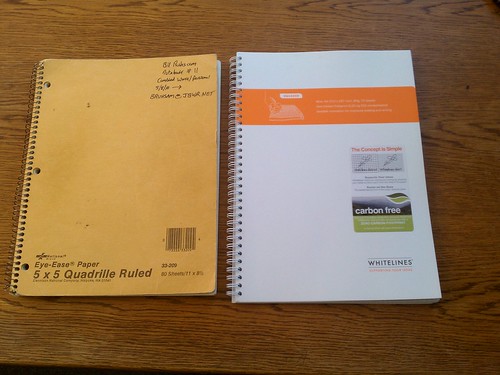
    Whitelines / Quadrille Comparison
    I am heartily entertained by the “Carbon Free” notation. If you don’t read the fine print, it implies that this was made with no carbon, rather than as a zero carbon footprint product, although I’m curious how they can produce something from raw materials in such a manner that they produce no carbon footprint. That’s counterintuitive to me. I’ll have to go look it up, later.

    This is the Whitelines wirebound A4 notebook. The wirebound was very important to me because I use both sides of my notebook paper and need to be able to fold it back without shattering the spine of the notebook. A4, of course, is one of those crazy non-American thingies dealing with paper size but it’s generally equivalent to 8.5″ x 11″, i.e. American Letter size.

    The quadrille nature of the paper is also important to me because it’s nice to have the lines keeping me in square. I’m not the worlds best free hand artist and I can use the squares to help keep me in scale.

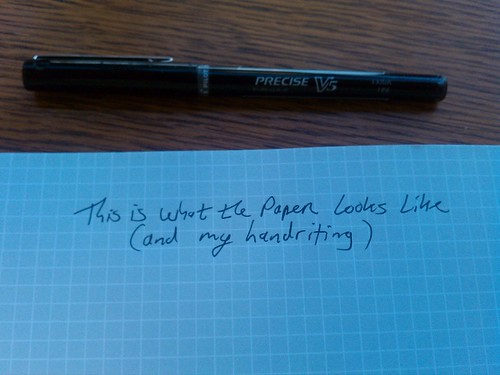
    IMAG0275.jpg

    The argument by the manufacturer is that the white lines on the paper shown above are better to use that the dark lines on more common graph paper. At first glimpse, I’m unconvinced that this will make a big difference to me when I’m working. It may make a difference when I go to photo copy the page, but that doesn’t happen very often.

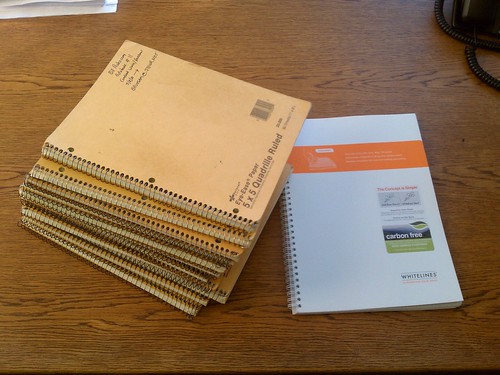
    Stack 'O Notebooks from work. Latest edition will be Whitelines

    Honestly, I just wanted to try something new for a change. I’ve spent a lot of time with that other notebook.

    Other remarks: the Whitelines book feels a bit floppier than the quad books I’ve been using. I’m also a bit worried that it’s not going to stand up to the abuse I give these notebooks (being thrown around, crushed into bags, stacked under books, generally treated poorly).

  • Modern US President

    Thanks, David, for passing this along to me. I am amused.

    (and it’s true: let the dude smoke if he needs to)

    You know, as I was about to push POST on this, I realized that I couldn’t think of any Republican videos or spoofs similar to this one. I mean, this is definitely a Pro-Obama, Pro-Democratic Party video. Where are all the funny and insightful videos for Republicans? There must be some (even though I think the universe of material is going to be much smaller).

  • Electoral Selections: Georgia 2010

    Without preamble, here are the ways I’m going this election season, and why:

    Georgia State Constitutional Amendment #1: “Shall the Constitution of Georgia be amended so as to make Georgia more economically competitive by authorizing legislation to uphold reasonable competitive agreements?”

    I will vote NO NO NO. This could also be stated, “Shall the Constitution of Georgia be amended to make employees less able to control their own futures?” Sure, this is a boon for businesses, but I regard this as something that should be addressed through employee retention policies and not forcing me (and you can be forced after hiring to sign these) to sign a non-compete agreement that is so broad as to disallow me from working in my field of expertise.

    Georgia State Constitutional Amendment #2: “Shall the Constitution of Georgia be amended so as to impose an annual $10.00 trauma charge on certain motor vehicles in this state for the purpose of funding trauma care?”

    This is a tax levied on all owners of private automobiles. Yes, it’s a tax. Yes, I’ll vote for it. Trauma hospitals are important and motor vehicles provide a lot of the supply of patients to them.

    Georgia State Constitutional Amendment #3: “Shall the Constitution of Georgia be amended so as to allow the Georgia Department of Transportation to enter into multiyear construction agreements without requiring appropriations in the current fiscal year for the total amount of payments that would be due under the entire agreement so as to reduce long-term construction costs paid by the state?”

    Ahh, something of which I have expertise! Yes, I’ll vote for this one, and you should, too. This doesn’t change the obligation of the state in funding projects, doesn’t change the costs, doesn’t change how people get paid, it only changes the way the contracts are obligated from fiscal year to fiscal year. Sure, it has a downside if the DOT gets discombobulated and stops funding projects; there would be half-finished roads everywhere, but this is still a good idea. Vote for it!

    Georgia State Constitutional Amendment #4: “Shall the Constitution of Georgia be amended so as to allow the Georgia Department of Transportation to enter into multiyear construction agreements without requiring appropriations in the current fiscal year for the total amount of payments that would be due under the entire agreement so as to reduce long-term construction costs paid by the state?”

    This one is basically the same as #3. If you vote for 3, you should vote for 4 and vice versa.

    Georgia State Constitutional Amendment #5: “Shall the Constitution of Georgia be amended so as to allow the owners of real property located in industrial areas to remove the property from the industrial area?”

    I have no earthly clue about this one. I have to go find out.

    U.S. Senate: Michael Thurmond (D). I’m voting for Commissioner Thurmond rather than for the incumbent Johnny Isakson (R) for social-justice reasons. I agree with Isakson’s positions on business and (somewhat) taxation, although he’s been holding the republican party line recently (“The Party of No”) however his positions on various social agendae I find repugnant.

    Georgia Governor: Former Governor Roy Barnes (D). I’ve voting for Barnes and against former U.S. Representative Nathan Deal. I haven’t put much thought into the GA Governor’s race because when Deal announced his candidacy, he also took up the position of a Birther, which is one of my few political litmus tests. If you’re a birther, you are either ignorant or pandering to the ignorant, and I will not vote for you. This issue is dead dead dead.

    On the other side of the coin, I’m also voting for Barnes for pocketbook reasons. I think he’ll be better for Georgia transportation funding than Deal would be. That spells continued employment for me.

    Georgia Lieutenant Governor: Casey Cagle (R-incumbent). I like Casey. He’s done good stuff. That’s enough for me

    Georgia Attorney General: Ken Hodges (D). I was going to vote for Sam Olens (R) the basis of the competency he displayed as the Commissioner of Cobb County, rather than his ideology. However, I realized that while I would support him in a run for Governor or Lt. Governor, I do not support him for Attorney General. He came out in the wake of the federal health care law as saying that if he were Attorney General, he would join the lawsuit challenging the law’s constitutionality. I don’t personally think there is any merit in that claim and I believe that this is a Republican fuck you to the American people. I don’t want him wasting my tax dollars on a frivolous lawsuit so Ken, you got my vote.

    U.S. Rep: Tom Price (R-incumbent). Running unopposed.

    State Rep: Don Parsons (R-incumbent). Running unopposed.

    State Senator: Chip Rogers (R-incumbent). I actually need to do some research into his opponent, Patrick Thompson, but at this time I think I’ll be voting incumbent.

    If you notice that there are a lot of things left off this list, it’s because I either don’t have an opinion yet, or haven’t done my research.

  • Conference/Convention Panels: How to not be an Annoying Audience Member

    2010-09-04_IMG_1733

    I’ve attended many conferences and society meetings and luncheons with speakers and seven (eight?) Dragon*Cons to date. I’ve sat in the audience for panels from such diverse topics as Wastewater Management to The Physics of the Buffyverse. These panels invariably have one thing in common, no matter the difference in the subject matter: Annoying Audience Members (AAM)1.

    Before I get into what makes an AAM, I must stipulate a few things:

    • The panel is interesting and does not require derailing for the continued mental health of the audience
    • The panel is an informational panel which features a question and answer session
    • The panel isn’t specifically designed to violate the things I’m about to talk about

    Making those assumptions, I have the following rules for Audience Members in order to avoid becoming an AAM:

    • Do not loudly agree/disagree with the relevant panelist to your neighbor while others are listening. This is common courtesy and should be observed by all persons. It’s especially important when the panel is set in a large room and the panelists are not properly mic’d. Be kind. Shut up
    • During the Question and Answer session please ask a relevant question. The definition of relevant can be divined from the published topic of the panel and from the actual topics being discussed by the panelists. As I just came out of Dragon*Con, I’ll pull examples from some experiences there: If you’re at a panel entitled “Brandon Sanderson talks about Everything” you can ask, well, anything. If the panel instead is “Brandon Sanderson discusses the Wheel of Time” then some of your fellow audience members will become peeved if you insist on asking about his writing process.
    • 2010-09-04_IMG_1742

    • If you’re at an Author Panel, please avoid asking them about their writing process or where they get their inspiration. I’ve polled a lot of people and there’s a 2/3 majority saying this is a stupid question. The only reason to ask it is because you might need some inspiration and there is a 99.9% likelihood that you can’t apply their methods to your art.
    • Never ever ever use the following words: “This is more a comment than a question….” Seriously, half the audience will want to pull out your innards and choke you with them. We’re (excuse me, “they’re”) not there to listen to you.
    • Ask good questions. This one is harder to define because what I define as a good question you might disagree with. However, we can talk about it from a structural perspective. A good question is short, to the point, and easily understood by the panelist. A great question is the same but elicits new information that the rest of the audience might not have heard before. As a personal note (and if you’ve ever attended any sort of panel with me, Dragon*Con or otherwise, you already know this) I like to ask questions but I only ask questions I think are good ones. I also listen to make sure the topic I want to question hasn’t been covered. There are fine shades here but you can get mileage out of old, tired things by applying a bit of thought. Going back to the Brandon Sanderson2 Wheel of Time panel3 the moderator got the usual question (“Who killed Asmodean”) out of the way before the panel even started but I found a twist. “Do you agree with Robert Jordan that we have enough information to know who killed Asmodean?”4 I think that’s a good question. Spend at least a bit of time rehearsing the question in your head and it will come out cogent and relevant.
    • When asking a multipart question, don’t. Single questions, thanks.
    • Going back to the “This is more of a comment…” item, it’s ok to give background to frame the question you’re asking, but refer to the “Ask Good Questions” for some improvement tips.
    • If there is a microphone, use it. If there’s not, project to the room. When using the microphone, stick that thing in your face. The closer it is to your lips, the better. We want to hear you; you might be asking a Good Question.5 Also, it’s not considered rude or inappropriate to spend five seconds adjusting the microphone and stand. This makes it much more comfortable for you.
    • When at professional events, it’s considered courteous to not question the panelist’s competence out loud. Seriously, I’ve heard this happen at engineering conferences. Bad form. Wait ’til afterward. There’s really only two things that can happen if you do this. 1) You’re right, but if it’s obvious that you’re right, there’s no reason to call it to attention. Other people will notice too. 2) You’re wrong and you just made an enormous ass of yourself in front of people who might be in a position to influence your career.

    Generally all these tips can be boiled down to: Be courteous, be relevant, and be there for the panel, not for you. If you choose to not follow these pointers, I assure you I remember the people I feel are wasting my time and the panelists’. Others do too.


    1: About half of them will have the Annoying Panel Member, but that’s another topic
    2: Brandon Sanderson is the author of Elantris, the Mistborn Trilogy, Warbreaker, The Way of Kings, and is now best known for being the author selected to finish Robert Jordan’s Wheel of Time Series.
    3: Which was awesome. He read from the Prologue to the next book, The Towers of Midnight and we got to watch this!
    4: If you want to know the history go here. His answer? Long and complicated but I interpreted it as “No.”
    5: This has a corollary for panelists: repeat the question. When I’m in front of an audience with a microphone, I always repeat the question. This serves two purposes: everyone can hear it and the questioner knows if you’re interpreting the question correctly.

  • Open Letter to the Hyatt Regency Atlanta

    September 16, 2010

    Hyatt Regency Atlanta
    265 Peachtree Street NE,
    Atlanta, Georgia, USA 30303

    To whom it may concern:

    Greetings! I am writing today for two reasons. First and most importantly to thank you for being a wonderful host institution for Dragon*Con. Those of us who are perennial attendees at this signature event appreciate the effort you undertake to make us feel welcome. I realize it must be trying to have a hotel packed with Wookies, Klingons, Slave Leias (well, maybe not the Leias), and all the shenanigans surrounding Dragon*Con, so thank you for being a wonderful host.

    This year was my first staying in your property. I enjoyed the experience, except for the four or five times I had to climb to the eleventh floor (which is a known issue with the Dragon*Con weekend). The rooms I stayed in was pleasant with plenty of space and I appreciated the city views outside on the balcony. If I had one criticism of the room it was the lack of counter space in the bathroom, but that’s something we managed to deal with.

    Also, I found the hotel staff to be courteous, professional and prompt once I got their attention. This brings me to crux of the matter that I’m writing about.

    On Monday when I was checking out, I decided to use the Bell Hop service to transport my numerous bags to the car I had parked in your facility. I called up the bell service desk at 11:10 or so and was informed I had a 45 minute wait. I could deal with that so I sat back and watched Dragon*Con TV on the hotel television. At 12:30 I rang the bell service desk to make sure I hadn’t been misplaced or forgotten. At that time I was informed of a 10 minute wait. At 1:15 I called again and demanded an honest, accurate assessment of my wait time before a Bell Hop would arrive. I was again informed 10 minutes and I’m happy to say that a bell hop arrived in nine. Total wait time was approximately two hours and ten minutes.

    This is a problem for two reasons: Inaccurate reporting of wait time and time that I could have been spending with the eight people I brought in from out of town to spend money in your hotel and Atlanta generally. I was highly resentful of the wasted time I could have been spending with my friends as opposed to waiting for a Bell Hop. I have two suggested solutions for you

    1. Accurately report what the wait times are going to be. I would have had no problem if you’d told me “two hours” when I made my initial call. I could have gathered some people to help me cart luggage to the garage.
    2. Add staff for the known huge outflux of patrons on days such as Dragon*Con checkout

    The first solution is the one I’d prefer. If you are honest with your patrons who are farther down the Bell Hop list, we’ll respect you for it and be able to plan our days accordingly. Otherwise our very last experience with your establishment will be a negative one, which will color our perceptions of the visit.

    Thank you again for being an excellent host hotel for Dragon*Con. I look forward to patronizing your establishment next year

    Bill Ruhsam
    Marietta, GA

  • Koran Burning: Thoughts

    Surely you have heard by now of the Gainesville, FL pastor who is planning to burn the Koran on Saturday as a commemoration of 9/11. If not, go to that link first and check it out.

    My thoughts, in order of their appearance when I heard the news:

    1. What a douchebag
    2. He’s going to cause a lot of trouble in the Islamic world
    3. If only he weren’t a douchebag
    4. But wait, shouldn’t Muslims just chill out and realize that this particular douchebag represents approximately one microspittle of the population of the US (50 parishioners)?
    5. Not the crazy ones, who are the ones who perpetrated 9/11 in the first place
    6. But isn’t this a free speech issue, at least from an American perspective?
    7. Oh! Great idea! We need to go to Gainesville on April 19 and burn some bibles to commemorate the Oklahoma City Bombing. Those guys were Christian after all.
    8. But wait! If we’re going to do that, we need to do something similar for the Jews and the Buddhists and the Shinto and the Hindus. We’ll have to find some nutjob anniversary for each of them too
    9. This could be a growth industry! There must be a way to monetize this

    And I can say all of these stupid inane things because I’m an American and I have the right to do so. Just like that dipwad in Gainesville has every right to burn the Koran if he wants. The unfortunate fact is that he’s doing it for the wrong reasons. He’s doing it because he believes that Islam is one of the (many I’m sure) tools of the devil trying to bring down the Godly plan of having Christians rule the world. I think he should do it just because he can do it. By stating that “I’m burning this Koran because I am an American and I’m exercising my right to do so” he would be striking a blow for the Christian Freedom of His Beloved Country, For Whom God Has Made a New Eden. Although he should also burn some other books as he does so, to emphasize the point.

    However, a man who is an obvious colleague of the Fred Phelps School of Hate probably doesn’t think quite that deeply about the inherent contradiction of the position he is maintaining. Here he is, in the first country in the world to enshrine in the highest law of the land the absolute right to a) burn that Koran and b) be a Muslim who hates him for it, and say so.

    Seriously, Gainesville. You need to find out what version of the bible this guy’s church uses and go have a nice weeney roast somewhere nearby.